

Think about the last time government affected your daily life. Maybe it was a hospital wait time. A classroom that was too full. A rent cheque that hurt a little more than the month before.
Chances are, that wasn't a federal decision. That was your province.
Provincial governments run healthcare delivery, public education, and housing programs. These are the things that touch your life every single week. And yet, for most Canadians, it's hard to know where their provincial politician actually stands on any of it.
That's something we wanted to fix.
Where PolicyShift Started
When we launched PolicyShift, we focused on the 343 Members of Parliament at the federal level. We tracked what they said in news articles from CBC, CTV, and Global News. We built profiles showing their positions on issues — in their own words.
It worked. People loved it.
And then they started asking: "What about my MPP? What about my MLA?"
That message came through loud and clear. So we got to work.
The Challenge: Canada Is Complicated (In the Best Way)
Adding provincial politicians sounds simple. It is not simple.
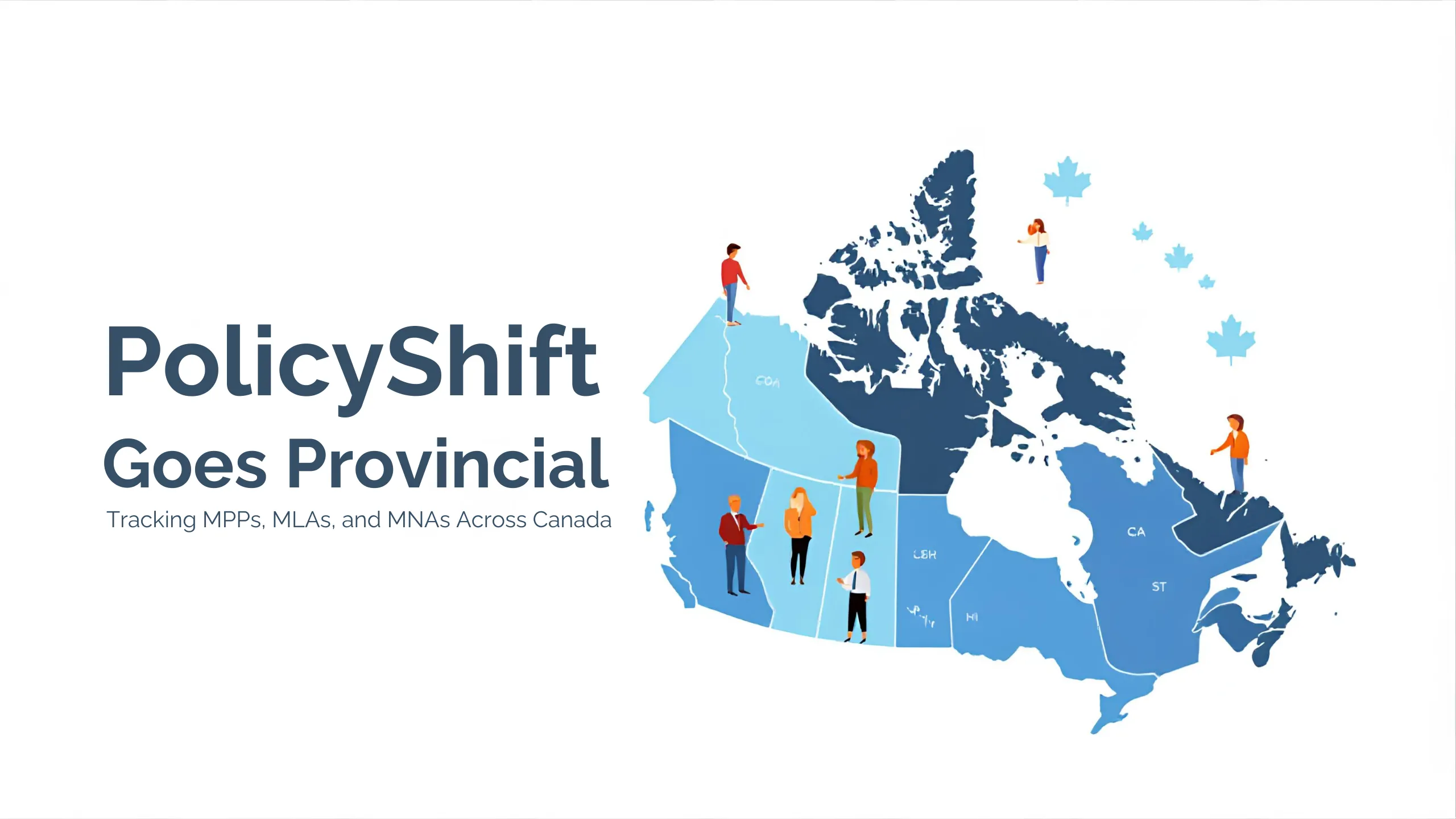
Canada has 10 provinces and 3 territories. Each one has its own legislature. Each one uses different job titles for elected members. In Ontario, they're MPPs. In most provinces, they're MLAs. In Quebec, they're MNAs. In Newfoundland, they're MHAs.
Each province also has its own political parties — parties that don't exist federally, and parties that don't exist anywhere else in the country.
We needed a system that could handle all of that without rebuilding everything from scratch for each new province. So we designed one.
Ontario: The First Province
Ontario was our pilot. With 124 seats at Queen's Park, it made sense to start there.
We compiled every sitting MPP from the Ontario Legislative Assembly, sourced official headshots, and mapped party affiliations. Then we hit a pleasant surprise.
Our existing article database — the one we'd been building for federal politicians — already contained thousands of articles mentioning Ontario politicians. Years of coverage from CBC, CTV, and Global News, all collected but never organized by provincial politician. We built a system to go back through all of it and surface provincial stances automatically. When Ontario MPPs launched on PolicyShift, they didn't have empty profiles. They launched with real policy history.
Making the experience easy to use was just as important as building the data. Switching between federal and provincial coverage had to feel effortless. On mobile, a new tab opens a province selector. On desktop, a simple pill bar lets you switch. Every label updates automatically — "MPs" becomes "MPPs," "House of Commons" becomes "Queen's Park." The URLs are clean and shareable.
We had plenty to sort out along the way — data bleeding across views, match counts not respecting filters, politicians with thin profiles at launch. We worked through all of it, and we shipped something we're proud of.
Quebec: Stress-Testing the System
Quebec came next — 125 MNAs — and it immediately threw us a curveball.
Names.
Our database had "François Legault." English-language news articles often wrote "Francois Legault" — no accent. To our matching system, those looked like two different people. We built a fix that treats accented and unaccented versions of names as the same person. As a bonus, this also improved matching for federal politicians with French names too.
Quebec also introduced a whole new cast of parties: Coalition Avenir Québec, Parti Québécois, Québec solidaire. Each one added and accounted for.
How Switching Feels in the App
One thing we were deliberate about: this had to feel natural.
If you're browsing Ontario politicians and you want to look up what's been said about international tariffs, PolicyShift searches across jurisdictions so you always find what you're looking for. No dead ends.
Every Ontario MPP gets the same depth as a federal MP. Same stance tracking, same timelines, same position-shift detection. A backbench MPP from a small riding gets the same treatment as the Prime Minister. We think that matters.
The Playbook: Any Province, Under an Hour
After Ontario proved the model and Quebec stress-tested it, we documented a repeatable process. All 13 jurisdictions — every province and territory — now have pre-built configuration slots in our system. Adding a new province is mostly a matter of compiling the politician data and flipping a switch.
What's Live Right Now
- 🇨🇦 Federal — all 343 MPs
- 🏛️ Ontario — all 124 MPPs
- ⚜️ Quebec — all 125 MNAs
- 🏔️ Alberta — all 87 MLAs
- 🌊 British Columbia — all 93 MLAs
The remaining provinces and territories are coming by mid-March 2026. Every province. Every territory. The same depth everywhere. And no new news sources needed — CBC, CTV, and Global News already cover the whole country.
Your Next Step
You now have more political accountability in one place than most Canadians have ever had access to before. So go ahead — give that province selector a tap, find your MPP, MLA, or MNA, and see what they've actually been saying about the issues that matter to you.
They work for you. Now you can check their work.